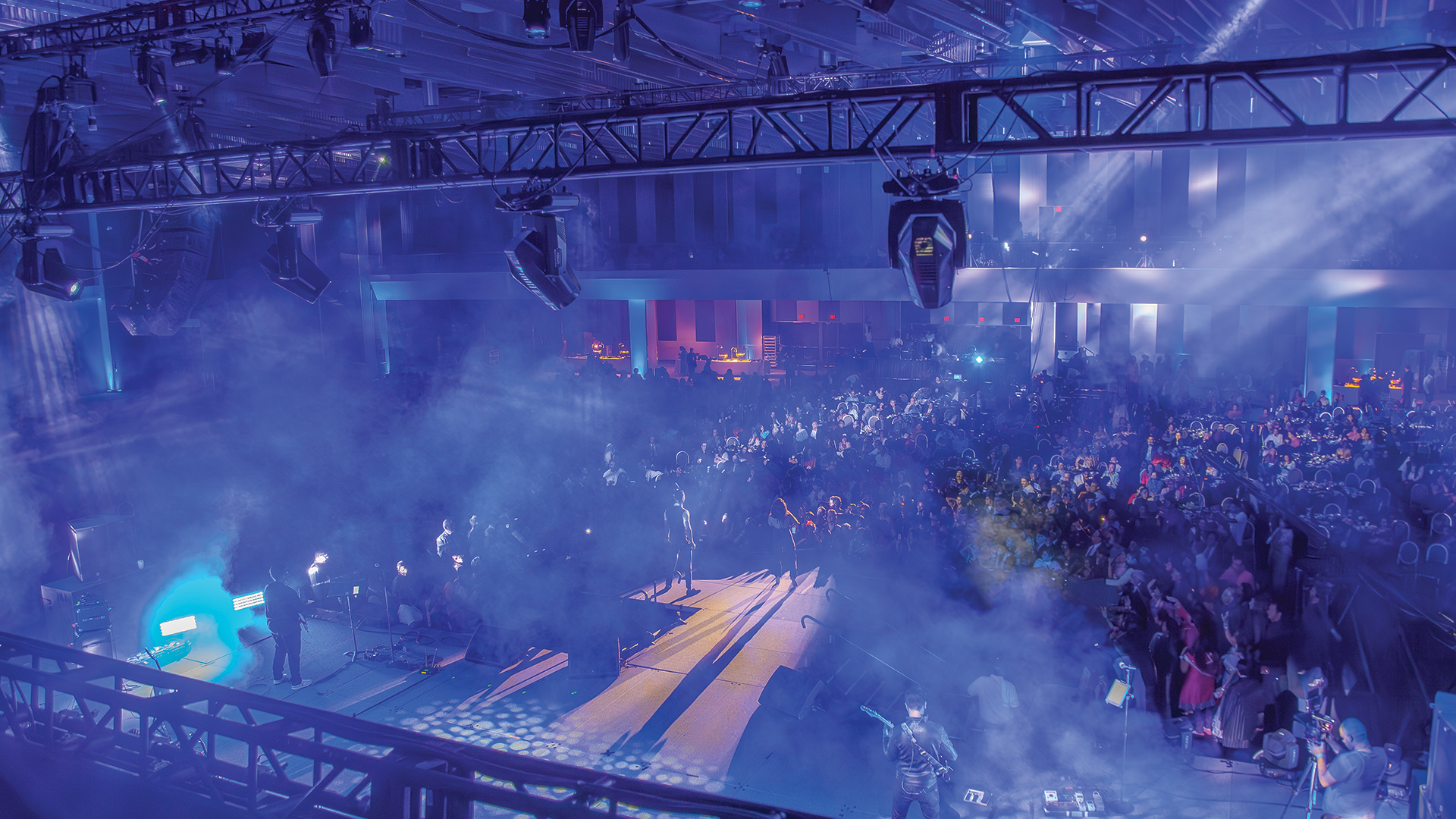
Atmospheric effects — fog, haze, smoke, and cracked CO2 — are among the most powerful tools in a production designer’s arsenal, and among the most technically unforgiving for the camera department. A stage bathed in the right density of particle haze can transform a corporate product reveal into something cinematic, make a lighting rig read with beams of volumetric light that elevate the entire visual language of the show. The wrong density, the wrong particle type, or an HVAC system that nobody thought to disable during the reveal moment will turn that same rig into a gray murk that makes every shot look like it was filmed in a foggy parking garage.
Fog vs Haze: A Critical Technical Distinction
The terms are often used interchangeably by people who don’t have to light through them, but for camera and lighting departments, fog and haze are functionally different atmospheric products with different production implications. Fog — produced by machines like the Hazer Pro, MDG Atmosphere, or Le Maitre G300 — creates visible, dense, low-hanging atmospheric layers. It scatters light aggressively, reduces visibility, and falls to the floor as it cools. Haze — produced by oil-based hazers like the MDG Atmosphere APS or High End Systems HazeBase — creates a fine particle suspension that hangs in the air, catches beam light without reducing overall visibility, and provides the volumetric lighting effect that makes rig beams visible in wide shots.
The choice between these two fundamentally shapes the camera’s response. Dense fog compresses depth of field perception, obscures background elements, and creates lens flare and ghosting as light sources are diffused by the particle cloud. Fine haze adds visual depth without compromising the camera’s ability to see clearly — it’s essentially invisible to the camera at proper density while being luminous under spot lighting. Understanding which effect the production designer intends is the first conversation the director of photography needs to have before any equipment is specified.
The Contrast Destruction Problem
The most persistent photographic challenge of atmospheric effects is contrast destruction. Any particle suspended between the lens and the subject scatters light back toward the camera — what photographers call veiling glare or atmospheric scatter. This scatter reduces the apparent contrast of everything in the frame, lifting black levels and compressing the dynamic range of the image. On a camera like the Sony VENICE 2 or ARRI ALEXA 35 with 16+ stops of dynamic range, this is manageable with careful exposure and color grading. On a multi-camera event setup with broadcast cameras like the Sony HDC-5500 or Panasonic AK-UC4000, the contrast loss can make IMAG screens look washed out and flat at exactly the moment the production designer is going for maximum drama.
The mitigation strategy is a combination of backlight-heavy lighting design (which creates separation between subjects and atmosphere), lens choice (longer focal lengths reduce the volume of atmospheric particles between lens and subject), and camera placement (moving cameras closer to talent reduces the particle column they’re shooting through). Lighting designers working in heavy atmospheric environments — particularly designers like Tom Kenny and Rob Halliday known for large-scale theatrical productions — specifically design key light positions to be as co-axial with the camera axes as possible, minimizing the scatter effect.
HVAC: The Atmosphere’s Worst Enemy
The most elaborate atmospheric rig in the world cannot survive a venue HVAC system running at full power. Air handling units designed to move thousands of cubic feet per minute through a large venue space will disperse even the densest fog in seconds, creating swirling, uneven atmospheric patterns that read on camera as chaotic rather than designed. The professional protocol is to request HVAC shutdown — or a switch to recirculation mode that eliminates fresh-air intake and exhaust — for the duration of any atmospheric-heavy sequence.
This requires advance coordination with the venue’s facilities team, and sometimes a formal fire life safety waiver — because fog and haze systems trigger smoke detectors in venues that haven’t prepared for theatrical atmospheric effects. Productions using the MDG Atmosphere APS — which produces a water-based haze that is specifically formulated to reduce false alarm triggers — still need to brief venue facilities in advance and often need detector isolation in the performance area.
Camera Settings and Lens Choices for Atmospheric Environments
Shooting in heavy fog or haze fundamentally changes the exposure equation. Atmospheric particles reflect light back at the lens, which means your apparent exposure level increases as haze density increases — even if the actual illumination on your subject hasn’t changed. Experienced camera operators account for this by establishing exposure benchmarks before the atmosphere is deployed, then making controlled adjustments as the atmosphere builds.
Lens selection matters enormously. Flare-prone vintage lenses — Leica R glass, Zeiss Contax, Super Baltars — can produce stunning, organic flare artifacts in atmospheric light that enhance the cinematic quality of the image. Modern cinema lenses with multi-layer anti-reflective coatings — Zeiss Supreme Primes, Cooke S7/i, ARRI Signature Primes — suppress flare aggressively, which may or may not serve the aesthetic depending on the production’s visual language. The conversation between the DP, the lighting designer, and the production designer about atmospheric density and lens character should happen before any equipment is on order.
Safety and Compliance Considerations
Atmospheric effect products used in enclosed production environments have occupational exposure limits that production companies have a legal and ethical obligation to respect. Oil-based haze fluids, while generally low-toxicity, can irritate respiratory systems with prolonged exposure at high densities. Water-based systems like those from MDG and Look Solutions have better respiratory profiles but still require adequate ventilation for crew working in the space for extended periods. OSHA guidelines on theatrical fog and haze, and the PLASA guidelines on the same subject, provide the framework that professional productions operate within. Ignoring them is not creative freedom — it’s liability.
