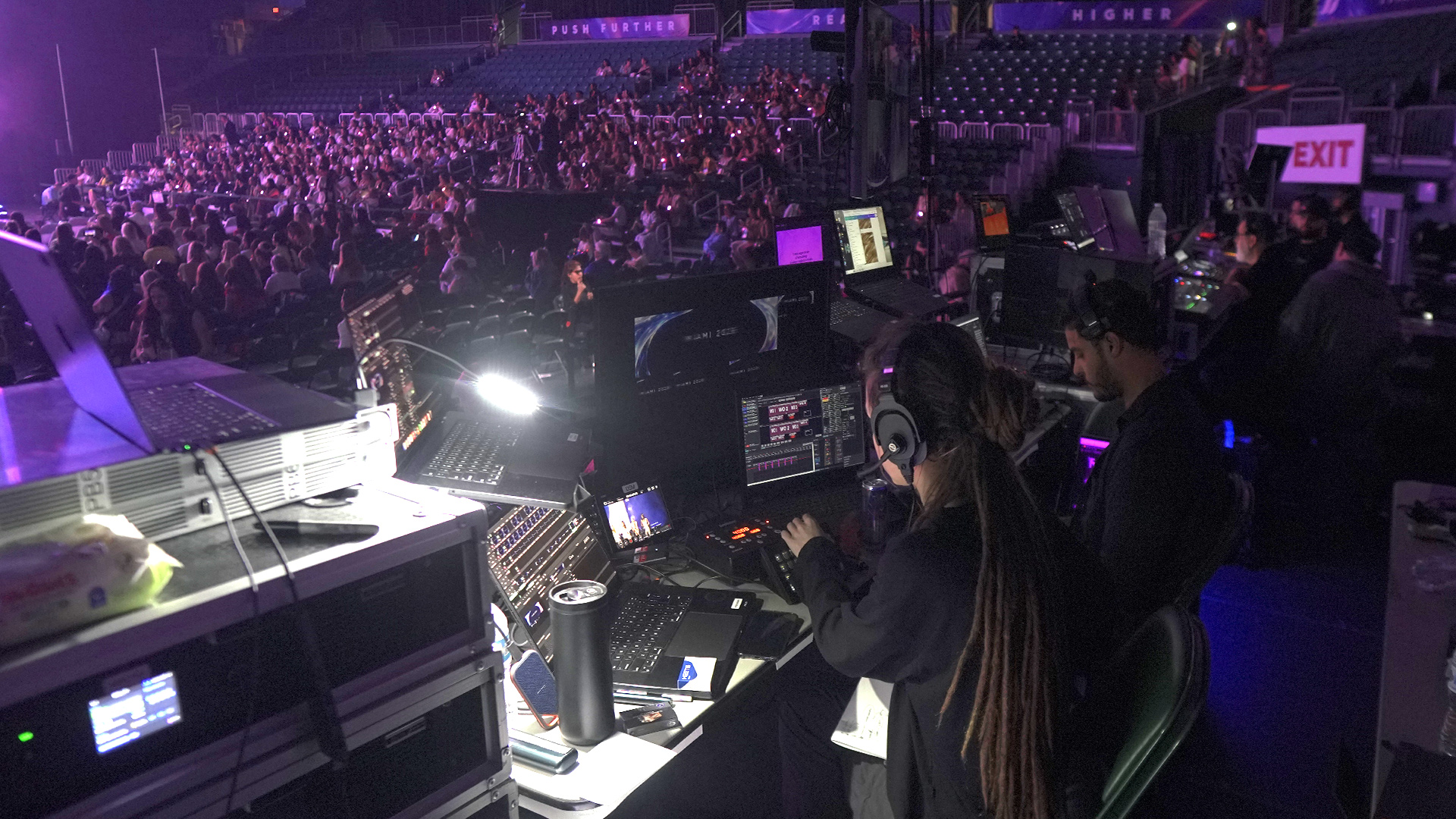
Sixty thousand people occupy a concert field in a way that no acoustic model fully prepares you for. They absorb sound, they generate their own noise floor, they create wind currents from collective body heat, and they fill a coverage area that — if you measured it on a map — would look about the size of a mid-sized city block extended to significant depth. Covering this human ocean with consistent, intelligible, emotionally compelling sound from a line array system supported by precisely calculated delay towers is an engineering and logistical achievement that the best touring production companies in the world execute routinely, and it is never as simple as the seamless result makes it appear.
The Physics of Covering 60,000 People
A 60,000-person audience field at a major outdoor festival typically extends between 180 and 250 meters from the front of stage to the rear audience boundary, with a width at the rear exceeding 200 meters at many sites. The main PA system — even a world-class L-Acoustics K1 or d&b J-Series deployment — achieves its maximum useful throw at approximately 100-120 meters before atmospheric absorption, inverse-square law SPL reduction, and ground-level reflections combine to reduce the direct sound level below the threshold of comfortable, clear listening. The rear 100 meters of a 250-meter field — occupied by perhaps 15,000 to 20,000 people — cannot be served adequately by the main PA alone. Delay towers exist specifically to bring the sound source closer to these audience zones, maintaining the SPL levels and the sense of sonic intimacy that the front-of-house audience receives.
Tower Design for Outdoor Mass Coverage
The delay tower configurations for 60,000+ person outdoor events are designed from the audience coverage geometry backward. The system designer begins with a map of the audience field, divides it into coverage zones defined by the audience density distribution and the available tower positions, and then specifies the speaker system for each tower based on the horizontal arc and depth that each tower must cover. A typical three-line delay configuration for a 250-meter field places towers at 80, 140, and 200 meters, with each line carrying L-Acoustics KARA II or d&b audiotechnik Y-Series elements configured to cover from their position to the next delay line. d&b ArrayCalc and L-Acoustics Soundvision are the primary design tools, both capable of importing the site topography and audience manifold geometry to predict the actual coverage including ground-level reflections and any site-specific obstruction.
SPL Management Across 60,000 People
The SPL management challenge on a 60,000-person outdoor show operates at multiple levels simultaneously. The front pit audience — potentially within 15 meters of the main PA — may experience SPL levels approaching 120 dB (A) during peak moments, while the rear field audience at 200+ meters receives perhaps 98-103 dB (A) — a differential that is physically unavoidable but must be minimized through system design. Noise limit compliance is an additional constraint at most outdoor festivals: local authority noise permits typically specify maximum SPL at the site boundary, measured at positions outside the audience field, and the system designer must ensure that the delay tower configuration achieves the required audience coverage while keeping boundary SPL within permitted limits. The L-Acoustics LA12X amplifier’s per-output limiting and d&b audiotechnik D80’s integrated protection limiting both play essential roles in maintaining these constraints without manual intervention during the show.
Iconic 60,000+ Person Festival Deployments
The documented record of delay tower deployments for 60,000+ person outdoor audiences provides the industry with reference cases that system designers study and adapt. Glastonbury Festival’s Pyramid Stage field — covering approximately 220 meters of depth with an estimated front-to-back audience gradient — has been served by d&b audiotechnik J-Series systems from production company Capital Sound across multiple festival years, with delay tower positions refined annually based on post-event SMAART measurements. Rock Werchter in Belgium, which regularly accommodates 85,000+ attendees at its main stage, deploys an L-Acoustics K1/K2 system with a four-line delay configuration that covers the site’s challenging 300-meter field depth. Download Festival’s main stage — operating on the Donington Park circuit grounds — uses four lines of delay towers to cover the 280-meter field that the site’s geometry creates.
Time Alignment Precision: The Millisecond Standard
The time alignment between the main PA and each delay tower line must be accurate to within ±0.5 milliseconds at the crossover zone between coverage areas — the position on the audience field where both the main PA’s acoustic output and the delay tower’s output reach approximately equal SPL levels. At this crossover zone, any timing error produces audible comb filtering: a phase cancellation effect that creates frequency-response coloration that is immediately perceptible to listeners positioned in the crossover zone. SMAART dual-FFT measurement is the standard verification tool, with the measurement engineer walking the crossover zone with a calibrated measurement microphone and verifying alignment at multiple positions across the zone width. The delay values are calculated from physical distance measurements between the main PA and each delay position — a straightforward calculation — but the frequency-dependent atmospheric delays caused by temperature gradients across the audience field require iterative SMAART measurement rather than pure calculation to achieve the ±0.5 ms alignment standard.
Subwoofer Distribution at 60,000-Person Scale
The subwoofer coverage question for 60,000+ person events is fundamentally different from the line array coverage question. Low-frequency wavelengths of 8-17 meters cannot be aimed or delayed in the same way as mid-high frequencies, and the standard delay tower speaker systems — carrying only the frequencies above 80-100 Hz — cannot contribute to the low-frequency SPL at their positions. The solution most commonly deployed at events of this scale is a combination of an exceptionally powerful main-stage subwoofer array — typically 24-48 d&b KS28 or L-Acoustics KS28 cabinets in cardioid end-fire configurations — and supplemental ground-stack sub arrays at the midfield positions where the main stage sub array’s output has begun to attenuate. Meyer Sound 750-LFC long-throw subwoofer elements, rated to 132 dB at 1 meter, have been deployed in midfield positions at several European festivals specifically for their extended low-frequency throw capability.
Sustainability and Efficiency at Scale
The energy consumption of a delay tower system covering 60,000 people is not insignificant, and the festival industry’s increasing focus on sustainability has begun to influence delay tower technology selection. The power efficiency advantage of Class-D amplification — d&b D80 and Lab.gruppen PLM+ 20000Q amplifiers both operating at over 90% efficiency — compared to the 50-60% efficiency typical of earlier-generation touring amplifiers, represents a real reduction in generator capacity requirements for remote delay tower positions. Reducing generator size from 60 kVA to 40 kVA per delay tower, across a four-line delay system with 8 towers, saves approximately 80 kVA of total generator capacity — a reduction that translates to measurably lower fuel consumption and CO2 emissions across a multi-day festival. Solar-supplemented power systems for delay tower amplifier racks have been piloted at several European festivals, with Ørsted-partnered Coldplay Climate Pledge Arena performances demonstrating that renewable power integration into touring audio infrastructure is technically viable at this scale.
