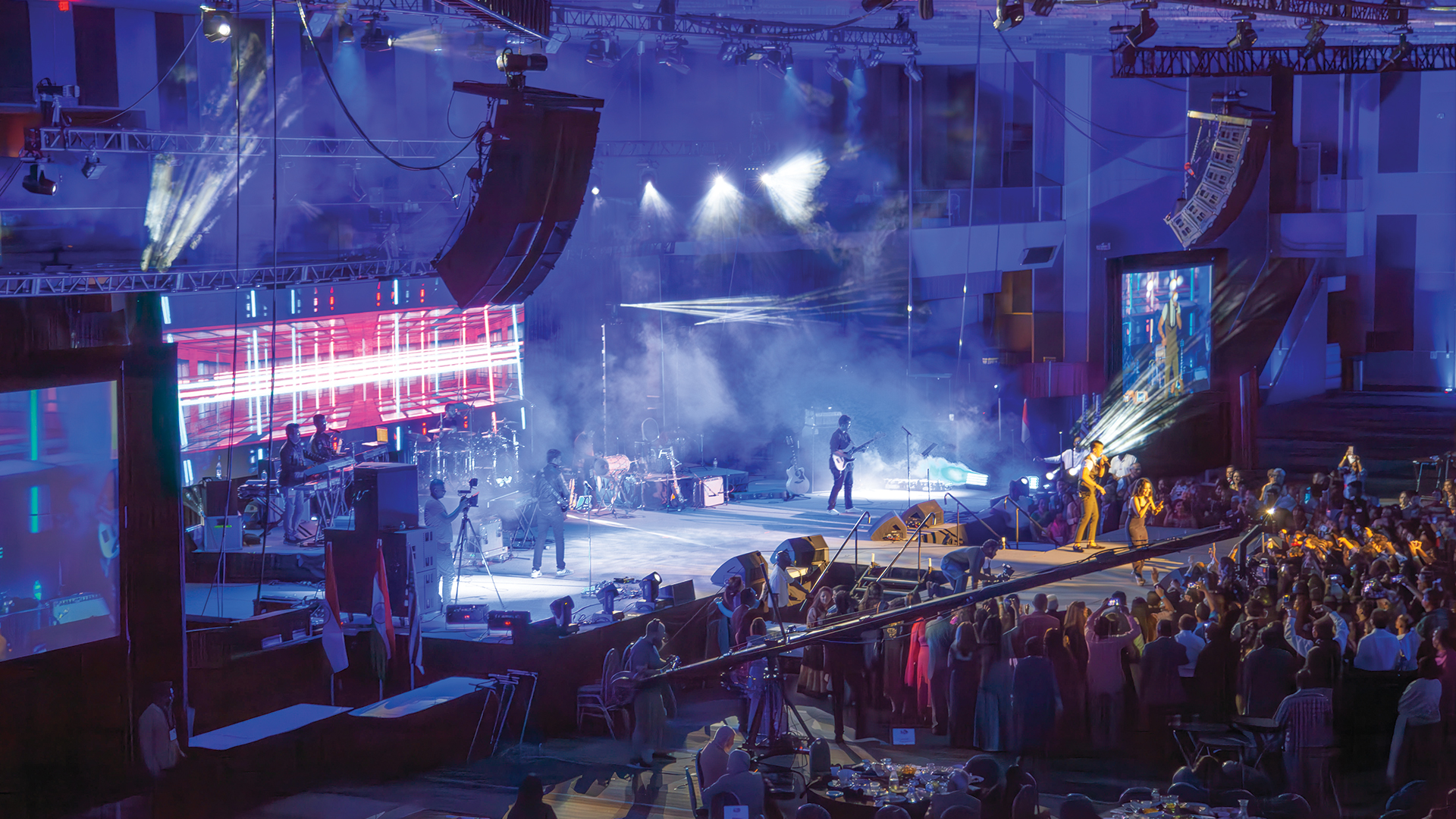
The delay tower serves a supporting role in large-scale sound reinforcement—extending coverage to distant audience areas while maintaining coherent timing with the main system. These structures should blend into the venue environment, delivering audio reinforcement without calling attention to their presence. Occasionally, however, delay towers develop theatrical aspirations, demanding attention through unexpected behaviours that transform them from silent servants into unwanted headliners.
The Festival Delay Towers That Announced Themselves
A sprawling outdoor festival deployed L-Acoustics A15 delay towers at strategic positions throughout the 80,000-capacity venue. The system engineer calculated precise delay times using GPS coordinates and Soundvision predictions, ensuring that audio from the towers arrived at listener positions simultaneously with wavefronts from the main K2 line arrays.
The first headliner’s set began with the delay towers performing exactly as designed—invisible acoustic extensions providing consistent coverage. Approximately 30 minutes into the performance, Delay Tower 3 developed different ideas about its role. The LA12X amplifiers powering that position began outputting a prominent 60Hz hum audible throughout the surrounding area.
Audience members near the tower found themselves unable to enjoy the music—the persistent ground loop noise overwhelmed programme content. The system tech assigned to that zone reported the issue, but venue constraints prevented immediate access for diagnosis. The tower had found its voice and insisted on sharing it throughout the remainder of the set.
The History of Distributed Sound Systems
The concept of distributed loudspeaker systems dates to the earliest public address applications. Political rallies and outdoor gatherings in the early twentieth century recognised that single point sources couldn’t adequately cover large areas. The development of electronic delay lines enabled time-aligned distributed systems, with early implementations using tape-based delay that introduced its own artifacts.
Digital delay technology revolutionised distributed sound, enabling precise timing adjustments measured in microseconds. Pioneers including Don Pearson at Ultrasound developed methods for outdoor sound that remain foundational. The introduction of Meyer Sound’s SIM analysis system in the 1980s provided measurement tools for verifying delay timing and system coherence that transformed delay tower deployment from art to science.
The Arena Towers That Echoed Themselves
A major arena production employed delay clusters rigged above the mixing position and rear seating areas. The d&b audiotechnik Y-Series cabinets were precisely aimed and delayed using ArrayCalc predictions verified through SMAART measurements during setup.
Opening night introduced an audience that altered the room’s acoustic characteristics significantly. The delay clusters, calibrated for an empty arena, now interacted with the audience-modified environment in unexpected ways. Reflections from the packed floor combined with delay cluster output to create comb filtering patterns that moved across the rear seating as people shifted position.
Audience members in affected areas heard a strange flanging effect on vocals and instruments—a sweeping, otherworldly coloration that suited neither the rock band’s aesthetic nor any reasonable audio quality standard. The delay clusters had become unintentional effects processors, adding creative processing that nobody requested.
Acoustic Interactions in Covered Venues
Indoor venues present acoustic challenges that outdoor deployments avoid. Reflective surfaces create paths for sound to reach listeners from multiple directions at different times. Delay systems must account not only for direct sound travel time but also for reflected energy that can interfere with intended coverage patterns.
The presence of audiences changes everything. People absorb mid and high-frequency energy while reflecting low frequencies—a transformation that affects the acoustic environment significantly. Systems calibrated in empty venues inevitably require adjustment when audiences arrive, though live performance constraints often prevent real-time recalibration.
The Stadium Towers That Competed With the Main PA
A stadium tour deployed ground-stacked delay towers using Meyer Sound LYON systems to cover upper bowl seating areas that the main LEO arrays couldn’t reach at acceptable levels. The delay positions were designed to reinforce the main system—providing level support while maintaining localisation toward the stage.
During setup, a network configuration error in the MILAN/AVB distribution assigned incorrect delay values to several tower positions. Instead of reinforcing the main PA, these towers began arriving ahead of the main system from the audience perspective. The precedence effect meant listeners near these towers perceived sound as originating from the towers rather than the stage—the delays had usurped the main PA’s authority.
Concertgoers in affected sections found themselves watching performers on a distant stage while hearing audio that appeared to emanate from massive loudspeaker towers to their sides. The experience created cognitive dissonance that multiple attendees reported as ‘watching a show on television while sitting in the studio’—technically acceptable audio from completely wrong apparent locations.
The Psychoacoustics of Source Localization
Human perception localises sound sources based on several cues, with arrival time differences playing a crucial role. The precedence effect (Haas effect) describes how the first-arriving sound establishes perceived source direction, with later arrivals integrated as spatial enhancement rather than separate sources—provided they arrive within approximately 30 milliseconds.
Delay towers exploit this phenomenon by delivering reinforcing energy slightly after the main system, ensuring that the earlier-arriving wavefront from the stage establishes localization. When delays arrive early, they become the precedence-establishing source, pulling perceived sound location away from performers toward the delay positions. The effect violates audience expectations fundamentally, creating confusion between visual and auditory stimuli.
The Conference Center’s Overenthusiastic Delays
A corporate conference deployed ceiling-mounted delay loudspeakers throughout a ballroom configured for 3,000 attendees. The system used QSC Q-SYS processing with automatic gain control designed to maintain consistent coverage levels regardless of programme content.
The automatic processing, intended as a convenience feature, developed its own interpretation of appropriate behaviour. During quiet moments in keynote presentations—dramatic pauses, thoughtful silences—the AGC circuits interpreted reduced signal as a call to increase gain. Background noise rose dramatically during these pauses, with the delay speakers amplifying room ambience, HVAC noise, and distant conversations.
Presenters learned to avoid rhetorical pauses as the delay system would fill any silence with amplified environmental noise. The delays had interpreted their programming as a mandate to ensure constant audio output—craving attention whenever the programme content failed to provide it.
Automation Versus Manual Control
The balance between automated audio processing and manual operator control remains contested territory in professional sound. Automation offers consistency and reduced operator workload; manual control provides artistic judgment and contextual awareness that algorithms struggle to replicate.
Modern processors from Biamp, Crestron, QSC, and others include sophisticated DSP capabilities that can manage complex systems with minimal human intervention. When properly configured, these systems enable consistent results across varying conditions. When misconfigured—or when conditions exceed their programming assumptions—they can create problems that human operators would immediately recognise and correct.
Keeping Delay Towers in Their Supporting Roles
Maintaining delay towers as invisible reinforcement rather than attention-seeking headliners requires disciplined approaches to system design, installation, and operation. Power distribution must be carefully managed to prevent ground loop issues that manifest as audible hum. Network configuration requires verification of every delay value before audiences arrive.
Level balancing between main systems and delays demands attention throughout performances. Environmental changes—audience fill, temperature shifts, atmospheric conditions—all affect the balance. System technicians assigned to delay positions should have communication with front-of-house engineers and authority to make adjustments when delays begin attracting unwanted attention.
The delay towers that crave attention teach humility about the complexity of distributed audio systems. What appears on paper as straightforward extension of main system coverage involves intricate interactions between electronics, acoustics, and human perception. The best delay deployments involve engineers who understand that success means invisibility—towers doing their job so well that audiences never suspect their existence. When delays start demanding attention, something has gone wrong that requires immediate intervention before the supporting cast becomes the inadvertent star of the show.
