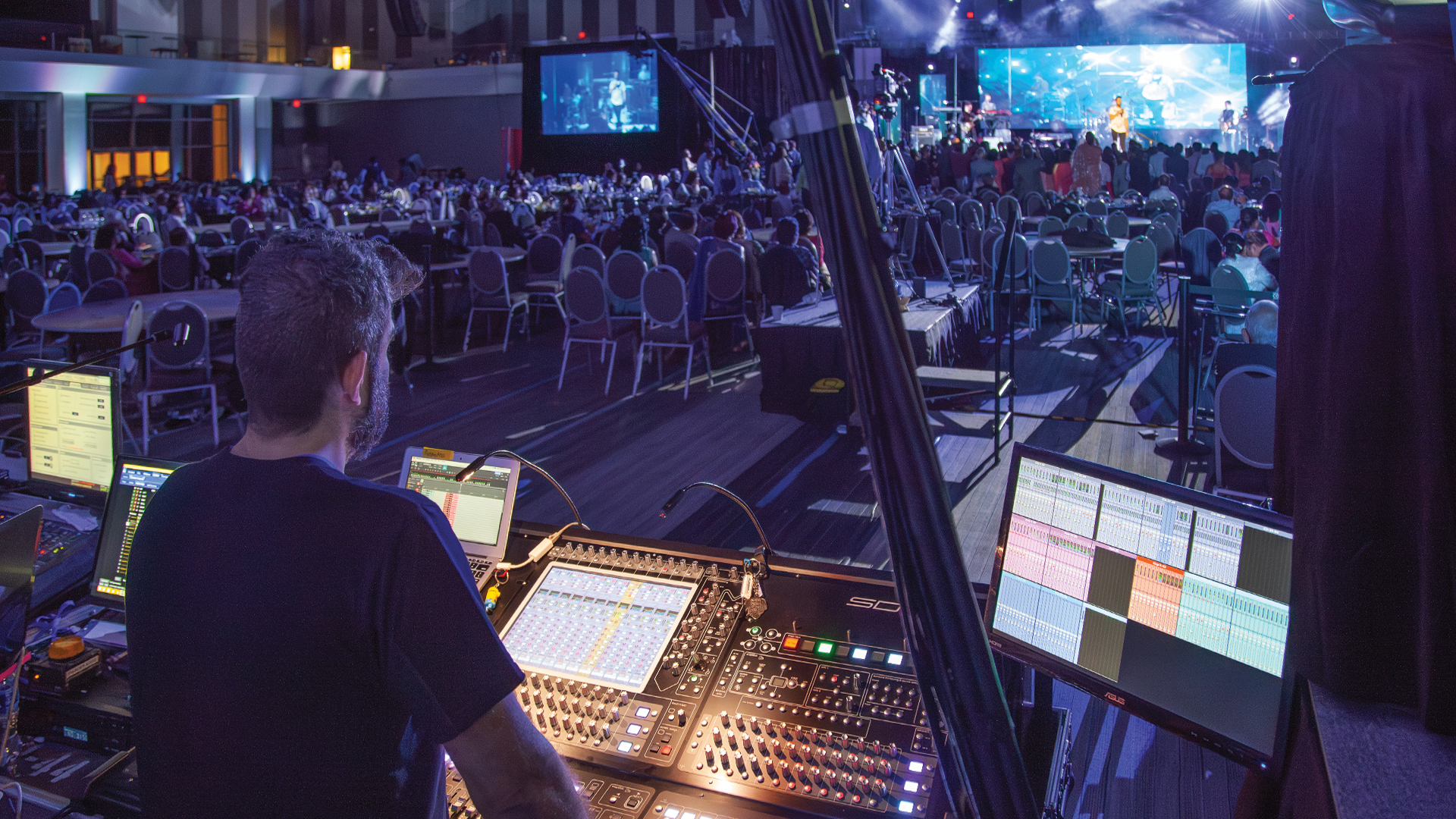
A well-designed sound reinforcement system should be invisible—translating the artist’s performance without editorial comment. But occasionally, a PA system develops ambitions beyond mere amplification. These are the stories of speaker arrays that decided they had musical contributions to make.
The d&b audiotechnik Harmonic Intervention
The d&b audiotechnik J-Series represents the pinnacle of line array technology—precision-engineered for transparent reproduction. System engineer Jennifer Park deployed a J-Series rig for a 2021 orchestral concert series and discovered that transparent reproduction has limits.
“The system was tuned perfectly—verified with SMAART and EASE Focus predictions. But during the Mahler symphony, we started hearing a resonance that wasn’t in the score. A sustained tone around 87Hz that would swell during the string sections. The conductor noticed before anyone else—asked if we’d added synthesizers to his orchestra.”
Tracking the Phantom Frequency
Park’s investigation led to an unlikely source. “We had a structural resonance between the subwoofer array and a load-bearing column. The SL-Subs were positioned perfectly according to the venue survey, but the column was sympathetically vibrating at the second harmonic of the fundamentals we were reproducing. The building itself was joining the band. We decoupled the subs using Sylomer isolation pads and the phantom musician disappeared.”
L-Acoustics K2 and the Feedback Composer
The L-Acoustics K2 system maintains its position as a touring standard through consistent performance and extensive dealer support. But FOH engineer Marcus Chen encountered a K2 deployment that developed what he describes as “compositional ambitions.”
“We were supporting a singer-songwriter—intimate material, lots of acoustic guitar and piano. The rig was appropriate: 16 boxes a side, LA8 amplifiers, plenty of headroom. During soundcheck, we started getting feedback that wasn’t feedback. Musical tones that seemed to emerge from interactions between the piano and the room, amplified and sustained by the PA in ways that shouldn’t have been possible.”
The phenomenon created what Chen calls “accidental counterpoint.” “The artist was playing in E minor, and the room kept adding a G# that shouldn’t have existed. We eventually traced it to a comb filtering interaction between the main array and a set of delay towers that were aligned for time but not phase-corrected at that specific frequency. The PA was effectively playing notes by selectively reinforcing room modes.”
Historical Perspective: When PA Systems Were Simpler
The evolution from early voice coil speakers to modern line arrays spans a century of audio engineering. The first practical loudspeakers, developed in the 1920s by companies like Western Electric and RCA, were designed for movie theater sound reproduction. Their limitations were well understood—they colored everything they reproduced.
The 1960s brought the JBL D130 and similar drivers that could handle the demands of rock and roll. The legendary Altec A7 Voice of the Theatre became the de facto standard for live sound, despite (or perhaps because of) its distinctive coloration. Artists learned to work with these systems’ personalities rather than expecting neutrality.
The Meyer Sound Self-Oscillation Incident
The Meyer Sound LEO system delivers remarkable output from a compact footprint, making it ideal for venues where visual sightlines matter. Audio engineer Sarah Vasquez deployed a LEO system for a jazz festival and encountered an unexpected collaboration.
“The system started generating tones during a bass clarinet solo,” Vasquez recalls. “Not feedback—self-oscillation. The Galileo Galaxy processor showed clean input, but the output included these ethereal overtones that seemed to harmonize with whatever the clarinetist played. Several audience members complimented the ‘electronic accompaniment’ after the show.”
Diagnosing the Musical Ghost
The investigation revealed a fascinating interaction. “We had a faulty crossover component in one cabinet that was creating harmonic distortion in a very specific frequency range—exactly where the bass clarinet’s third and fourth partials lived. The distortion products happened to be musically consonant. The PA was essentially performing tube-style harmonic enrichment by accident. We replaced the cabinet, and the ghost musician departed.”
JBL VTX and the Time-Delayed Duet
The JBL VTX A12 system offers flexible coverage patterns through its adaptive waveguide technology. System tech Robert Chen deployed a VTX rig for an outdoor amphitheater show and discovered an unintended consequence of long-throw optimization.
“We had delay towers at 150 feet serving the lawn section. The time alignment was set using ArrayCalc predictions and verified with measurement. But a temperature inversion during the show changed the speed of sound gradient across the venue. The delays started arriving early, creating a chorus effect that made every vocal sound like it had a ghostly double.”
The effect was subtle but noticeable. “The headliner actually thought it sounded interesting—asked if we could keep it. We explained that the atmospheric conditions creating the effect would shift throughout the night, potentially turning ‘interesting’ into ‘problematic.’ We implemented real-time delay compensation using temperature sensors feeding into the Crown I-Tech HD amplifiers’ DSP.”
Practical Approaches to PA Personality Management
Managing a PA system’s tendency to contribute unauthorized musical content requires systematic approach. The foundation is comprehensive measurement—understanding how the system interacts with every venue before the artist arrives.
Deploying multiple measurement positions across the coverage area reveals interaction patterns that single-point measurements miss. Tools like SMAART, Rational Acoustics Smaart Di, and SATlive provide the data needed to identify potential problem frequencies before they become musical contributors.
Processing Chain Verification
Every component in the signal chain can introduce artifacts that manifest as PA participation. Verifying signal integrity from console output through amplifier input isolates problems to specific components. The Audio Precision APx555 analyzer provides THD measurements that identify distortion sources with surgical precision.
Regular maintenance prevents the component degradation that leads to harmonic artifacts. Speaker reconing schedules, crossover inspection, and amplifier calibration maintain the neutral character that professional sound reinforcement demands.
The Subwoofer Frequency Generator
Subwoofer systems present particular challenges because their output exists at frequencies where room interaction dominates. System engineer David Williams deployed a Martin Audio MLA Compact system with MLX subwoofers for a club installation and discovered architectural acoustics with musical opinions.
“The room had a standing wave at exactly 63Hz—a perfect musical note. Whenever the DJ played anything with significant content at that frequency, the room would sustain and amplify it long after the music had moved on. The subs weren’t adding anything; they were exciting a room resonance that acted as a note generator. We installed parametric filtering on the sub output specifically to tame that frequency, effectively muting the room’s instrumental contribution.”
The pursuit of transparent sound reinforcement continues, but the best engineers recognize that every system exists within an acoustic environment that has its own voice. Managing that interaction—preventing the PA from joining the band uninvited—defines the craft of professional sound. The systems that serve artists best are the ones whose operators understand both the technology and the physics of the spaces they fill.
