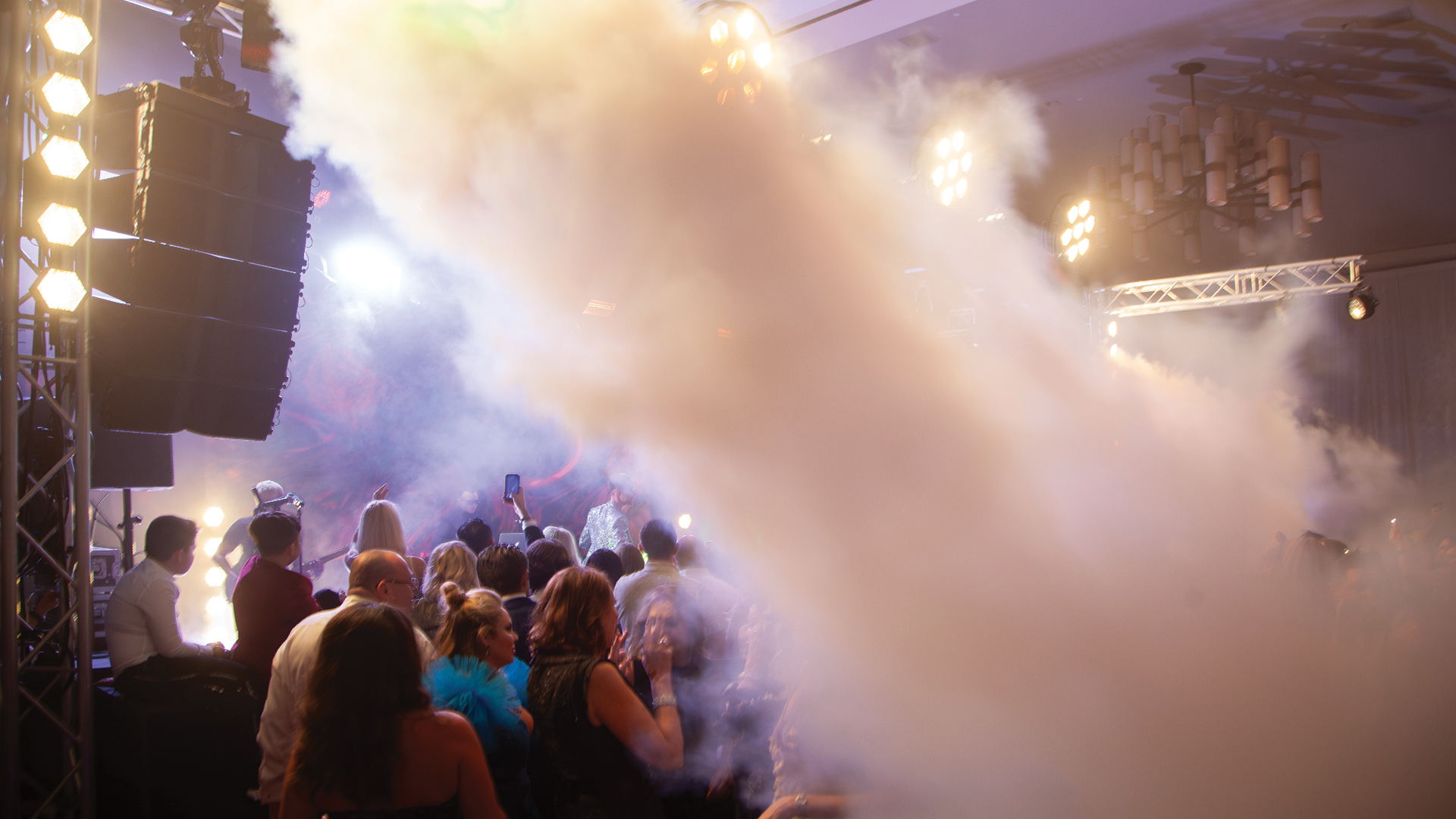
The dramatic fog burst that punctuates a song’s climax should dissipate gracefully, allowing the next number to begin with clear sightlines and fresh atmosphere. When atmospheric effects decide to overstay their welcome, productions discover that fog possesses remarkable staying power—and opinions about when visibility should return.
The Science of Stubborn Suspension
Theatrical fog fluid vaporizes into microscopic droplets that scatter light and create visible atmosphere. These particles—typically between 0.5 and 40 microns in diameter depending on equipment and fluid formulation—remain airborne through Brownian motion, that random molecular movement that keeps small particles suspended indefinitely in still air. The MDG ATMe produces exceptionally fine particles that can persist for hours without dissipation.
Fog dissipation depends primarily on air circulation—particles eventually contact surfaces and condense, or ventilation systems carry them away. Venues with aggressive HVAC systems clear atmospheric effects quickly, while spaces with minimal air movement allow fog to accumulate beyond intended density. The corporate ballroom with twelve-foot ceilings and sealed windows becomes a fog storage container rather than a performance environment.
Fluid Chemistry and Persistence
Different fog fluid formulations produce effects with varying persistence characteristics. Glycol-based fluids from manufacturers like Ultratec and Froggy’s Fog come in quick-dissipating and long-hang varieties specifically designed for different production requirements. Selecting the wrong formulation for venue conditions transforms brief atmospheric moments into extended visibility challenges.
The glycerin content in fog fluid directly affects hang time. Higher glycerin concentrations produce fog that lingers beautifully for concert applications where sustained atmosphere enhances the visual experience. That same formulation used at a corporate event where executives need to read teleprompters creates problems that no quick thinking can solve once the fog fills the room.
Temperature Inversions
Certain atmospheric conditions create temperature inversions that trap fog at specific heights. Cool air near the floor overlaid by warmer air above creates a stable boundary that fog particles cannot cross. The production that tested effects during afternoon soundcheck—before air conditioning created layered temperatures—discovers during the evening performance that fog pools where it was deployed rather than dispersing throughout the space.
Outdoor venues present even more complex thermal environments. Evening cooling creates ground-hugging fog effects naturally, and machine-generated fog combines with these conditions unpredictably. The fog intended to create mysterious atmosphere at stage level might rise unexpectedly as convection from lighting heat creates updrafts, or it might spread laterally into audience areas as cool air currents carry particles away from intended positions.
The Accumulation Problem
Productions that deploy fog throughout extended events face cumulative density challenges. Each burst adds particles to an environment that cannot clear them fast enough. The Martin JEM ZR45 produces impressive output that looks spectacular during isolated cues—and creates impenetrable haze when multiple cues fire throughout a ninety-minute set without adequate ventilation between them.
Experienced lighting designers program conservative fog output for venues with poor air circulation, accepting less dramatic individual moments in exchange for maintained visibility throughout the show. The choice between impressive fog bursts and consistent sightlines forces compromises that less experienced designers sometimes fail to anticipate until the venue fills with persistent haze.
Historical Fog Disasters
The theatrical fog history includes legendary incidents where atmospheric effects overwhelmed productions. Broadway shows have stopped performances when fog density prevented performers from seeing each other on stage. Corporate events have evacuated venues when fire alarm systems interpreted excessive fog as actual smoke. Concert productions have discovered that fog accumulated past the point where spotlights could penetrate to illuminate the performers they were designed to feature.
The original production of The Phantom of the Opera in 1986 developed sophisticated atmospheric protocols after early performances revealed how quickly fog could overwhelm the cavernous theater. Those protocols—specifying output volumes, timing, and ventilation requirements—became templates that subsequent productions adapted for their specific venues.
Fire Alarm Negotiations
Smoke detectors and theatrical fog maintain a tense relationship that requires careful management. Modern optical smoke detection systems interpret suspended particles as potential fire indicators—exactly what theatrical fog produces in abundance. Production teams must coordinate with venue fire safety officials to establish protocols that allow atmospheric effects without triggering expensive and embarrassing false alarms.
Some venues require fire watch personnel stationed throughout the space when fog effects are in use, ready to verify that alarms result from theatrical effects rather than actual emergencies. Others demand complete isolation of fog-producing areas from detection zones—practical in theaters designed for such separation, nearly impossible in multipurpose venues where detection coverage cannot be modified.
Ventilation Strategies
Professional production managers include ventilation assessment in their advance planning. Site surveys note the position and capacity of air handling systems, the availability of doors that can provide natural exhaust, and the presence of fans or other circulation equipment that might help clear accumulated fog. This intelligence shapes decisions about fog machine selection, fluid choice, and programmed output levels.
Temporary ventilation solutions sometimes supplement inadequate venue systems. Industrial fans positioned to create airflow paths can dramatically improve fog clearance rates. Some productions deploy air curtains that create boundaries preventing fog from spreading into audience areas. These interventions add complexity and cost but prevent the alternative—fog that refuses to fade and transforms carefully planned atmospheric moments into visibility emergencies.
The Operator’s Dilemma
The special effects operator controlling fog output faces real-time decisions that balance artistic intent against practical visibility. The designer programmed specific output levels for each cue, but venue conditions might demand deviation from those specifications. Too conservative, and the effects lose impact; too aggressive, and the fog overwhelms the production.
Communication between fog operators and stage managers allows real-time adjustment based on observed conditions. A stage manager watching fog density climb toward problematic levels can call for reduced output before visibility fails. This active management acknowledges that fog behavior cannot be fully predicted and that human judgment must supplement programmed automation.
Living With Atmospheric Persistence
The most successful atmospheric effects result from acceptance that fog possesses its own timeline. Productions designed around fog behavior—allowing recovery time between cues, choosing appropriate fluids for venue conditions, incorporating ventilation capacity into technical planning—achieve consistent results. Productions that fight fog physics inevitably lose.
The fog that refuses to fade teaches patience and respect for the atmospheric medium. These suspended particles transform light, create depth, and enhance visual drama through their very presence. Managing their persistence requires understanding their behavior rather than merely commanding their deployment. The production that learns to work with fog’s natural tendencies achieves effects that complement the performance rather than competing with it for audience attention.
When fog decides to linger, wisdom lies in adaptation rather than frustration. The atmospheric effect has opinions about its own timeline—and those opinions, properly anticipated, become part of the production’s vocabulary rather than obstacles to its success.
