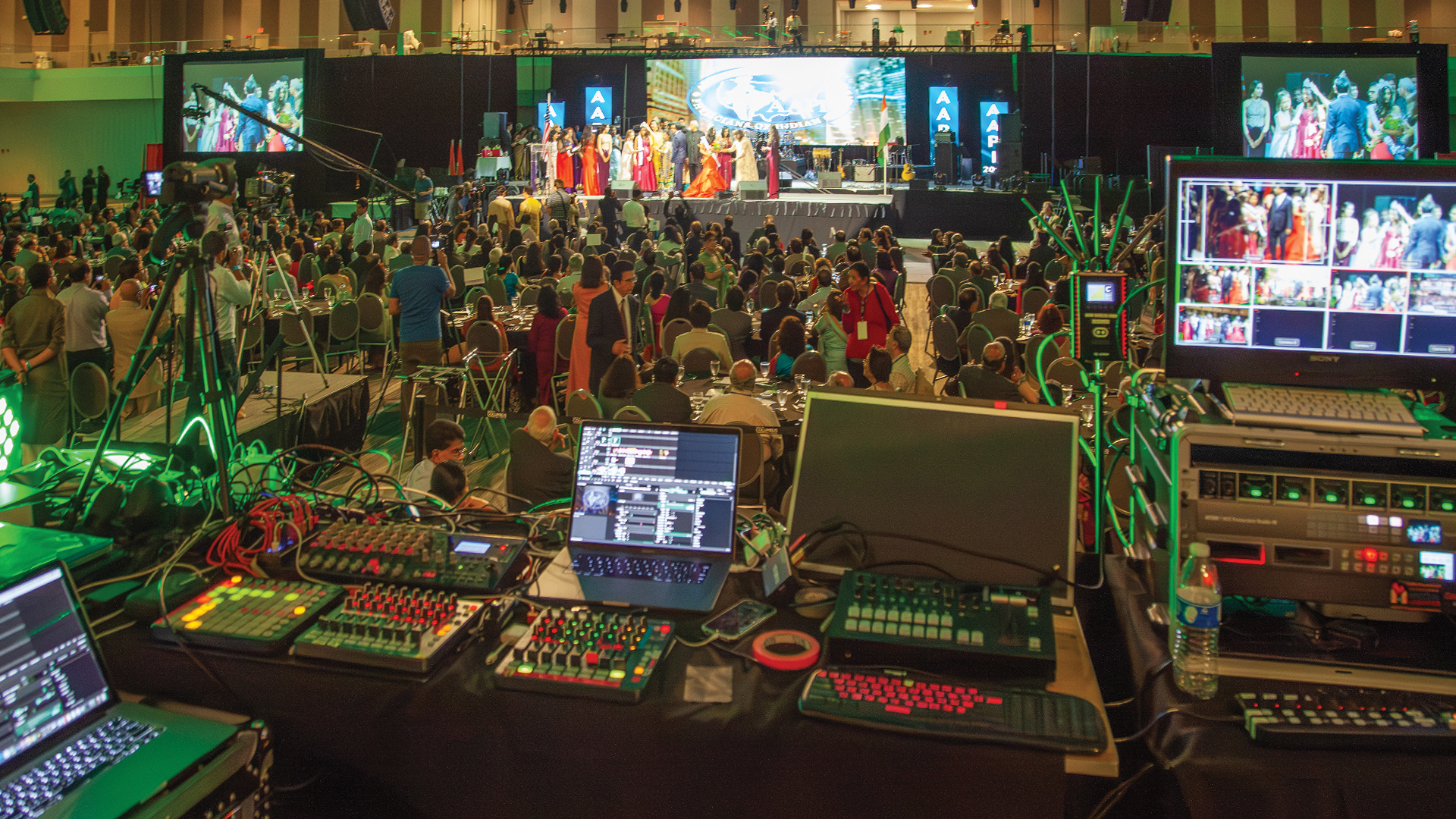
Stadiums are, from a RF engineering perspective, one of the most hostile environments on the planet. Tens of thousands of smartphones, tablets, and wireless devices in a compressed space create a noise floor that can render conventionally designed wireless microphone and IEM systems unreliable. The scale of the venue forces antenna placement strategies that strain the propagation models used in smaller venues. The structural steel and concrete that make a stadium durable become a multipath reflection nightmare for wireless signals trying to maintain phase coherence between transmitter and receiver. And the regulatory environment governing RF spectrum in sports venues — particularly post-2017, following the FCC’s repacking of the 600MHz band — has compressed the available spectrum to a fraction of what engineers had access to a decade ago.
The Spectrum Crunch: Post-700MHz Realities
The FCC’s 2017 incentive auction reclaimed the 600MHz band from broadcast television and reallocated it to mobile carriers, eliminating what was the most reliable wireless microphone spectrum available to live event production. The 700MHz band had been similarly reallocated in 2009. The practical effect is that wireless microphone systems are now competing in an increasingly narrow slice of UHF spectrum — primarily 470-608MHz — alongside legacy broadcast users, licensed Part 74 users, and unlicensed ISM devices. In a major sports venue hosting a large-scale production during a sold-out event, available clean spectrum is a finite and contested resource.
Professional wireless systems — Shure Axient Digital, Sennheiser Digital 6000, Sony DWX — include ShowLink and LinkCal spectrum scanning tools that survey the RF environment before frequency coordination. In stadium environments, RF coordination software like Shure Wireless Workbench or Sennheiser WSM is not optional — it’s the foundation of a workable wireless system. Manually selecting frequencies without spectrum analysis in a stadium is an act of professional negligence.
Antenna Placement and Distribution in Large Venues
The inverse square law governs wireless signal propagation: signal strength decreases as the square of the distance from the transmitter. In a stadium where the performance area may be 60-80 meters from the furthest antenna position, the path loss is extreme. Compensating for this requires either high-gain directional antennas pointed at the transmission zone, distributed antenna arrays that bring receivers closer to transmitters, or active antenna distribution amplifiers that cascade multiple receive channels from strategically placed antennas.
Products like the Shure UA874 directional antenna, the Wisycom MCR42S multichannel receiver with distributed antenna inputs, and the RF Venue DISTRO9 HF antenna distribution system are designed specifically for the scale challenges of large venues. In the largest stadium productions, active antenna combiners are positioned at the FOH position, at the stage, and in the field of play if talent mobility demands it — with coaxial distribution runs kept to lengths that don’t exceed the system’s noise figure budget.
Intermodulation and Frequency Coordination at Scale
A stadium production with 40+ wireless channels — microphones, IEMs, guitar systems, camera hops, intercom channels — creates an intermodulation product landscape that can generate hundreds of potential interference frequencies within the available spectrum. Intermodulation (IM) occurs when two or more signals mix in a receiver or in the RF environment to produce sum and difference frequencies that land exactly on a clean channel you thought was clear. At 40+ channels, 3rd-order IM products alone can theoretically fill every available frequency in UHF.
Managing this requires not just spectrum scanning but mathematical frequency coordination — assigning frequencies such that no two frequencies and their intermodulation products land on any other assigned frequency. Shure Wireless Workbench’s IAS (Intermodulation Analysis System) algorithm and Professional Wireless Systems’ coordination services perform this calculation automatically. For stadium-scale productions, engaging a dedicated RF coordinator — a specialist role that has emerged as a distinct AV profession over the past decade — is standard practice on any show with more than 20 wireless channels.
Stadium Infrastructure and RF Pollution
Modern stadiums are themselves significant sources of RF energy. DAS (Distributed Antenna Systems) installed by mobile carriers to provide in-stadium cellular coverage emit continuously in the 700MHz-2.7GHz range. WiFi access points blanketing the concourses and seating areas operate in the 2.4GHz and 5GHz bands. The LED scoreboard systems — particularly older installations with unshielded driver electronics — emit broadband RF noise across wide frequency ranges. All of these sources contribute to the noise floor that wireless microphone receivers must overcome.
The professional response is to request the venue’s RF environment documentation before the show — the carrier frequencies and output power of the DAS system, the WiFi channel plan, and any known RF noise sources. This information, combined with an on-site spectrum survey using a portable spectrum analyzer like the Kaltman Creations Flexscan SC1 or Rode RF-Explorer, provides the complete picture needed for reliable frequency coordination. In the absence of this documentation — which venues are sometimes reluctant to provide — arriving early for a thorough on-site survey is non-negotiable.
Building Redundancy Into Stadium Wireless Systems
Given the inherent uncertainty of RF environments at stadium scale, system redundancy is a professional obligation, not an optional upgrade. Hot spare transmitters pre-programmed with show frequencies and fitted with capsules, sitting in the hands of a deck tech at the stage, can be swapped into the hands of a performer in under 30 seconds when a transmitter fails. Receiver redundancy — a second receiver tuned to the same frequency, with audio output normalled to the console — provides automatic failover without any human intervention. In stadiums, where RF dropout can occur unpredictably due to multipath, crowd movement, or interference, redundancy is what keeps the show running.
